Wednesday, 20 April 2016

Dao De Jing

The past few evenings I read the Dao De Jing as translated by Roger T. Ames and David L. Hall.   Rozann put it in my stocking this past Christmas, it is not the type of book I would normally pick to read.  Philosophy in general is obsolete.  However Rozann is traveling this week, and the books I have been reading I managed to leave behind in the Santa Clara office.  So I needed to do something during my off hours this WW -- one thought from each chapter:


Chapter 1:
 The nameless is the fetal beginnings of everything that is happening,
            While that which is named is their mother.
              
             Google was a backrub in 1996.

Chapter 2:
 As soon as everyone in the world knows that the beautiful are beautiful,
            There is already ugliness.

The smuts we are, we can't help but to put things in boxes, and then label the box before filing. It is too hard not to.

Chapter 3:
               Not prizing property that is hard to come by
               Will save them [others] from becoming thieves.

The Dao De Jing was writing in the Iron Age as was the Hebrew Bible; these were horrible times in human history.  It was a very dark time after successes of humanity in the Bronze Age were lost.  Mothers didn’t expect their kids to make it to adulthood.  If you had something good, you were best to keep it to yourself.

Chapter 4:
               I do not know whose progeny it is;
               It prefigures the ancestral gods.

I like this idea; we think of 600BCE as the ancients.   It is obvious from this phrase the Chinese in 600BCE had their own concept of ancients to them.  And it makes me consider those who will live on Earth in the year 4000CE will look at us as their ancients.

Chapter 5:
The heavens and the Earth are not partial to institutionalized morality.

This phrase stands on its own; it did then, it does now.

Chapter 6:
               The life-force of the valley never dies.

They didn’t understand (or even care as far as I can tell from the reading) what happens when the Sun runs out of hydrogen.  I suppose I don’t care either, as it is so far off, but we do know now that we live in a special time, a time where we have a visible universe.  Billions of years from now the universe grow dark, and the life-force will die.  Iron Age ignorance bliss it seems.

Chapter 7:
The reason the world is able to be lasting and enduring
Is because it does not live for itself
This it is able to be long-lived.

This reads like complete garbage, what a philosopher from Sedona would tell you today if you paid them to read the lines in your hand.
                 
Chapter 8:
               The highest efficacy is like water,
               It is because water benefits everything.

               Good thought for thinking inward – and outward.

Chapter 9:
               It is better to desist
               Then to try to hold it upright and fill it to the brim.

Many things come to mind when digesting this thought, most of them will be smarter than my comment to follow; but hey, let’s face the music and dance tonight while the moon is still out – tell me the rest tomorrow.

Chapter 10:
Are you able to become a newborn babe?

No, Nix, Go fish.

Chapter 11:
This chapter is 100% philosophical rubbish, nothing worth quoting.

Chapter 12:
               The five flavors destroy the palate.

I am sure this is an early version of Matthew’s “no one can serve two masters”.   But if the author were to watch the food network in 2016, different words would have been used.

Chapter 13:
 . .  whenever favor is bestowed, both gaining it and losing it should be cause for alarm.

All primates are sentient social beings who will come into favor and drop out of favor.  To not do so would be as expected as it would be for teenagers to abstain from sex.   But, I would agree, it is good to keep track of when favors come and go; smart.

Chapter 14:
               Groping and yet not getting it
               We thus call it “intangible.”

               The author never met Jake Plumer.

Chapter 15:
               Muddy water, when stilled, slowly becomes clear;
               Something settled, when agitated, slowly comes to life.

Like ten chapters earlier; This phrase stands on its own; it did then, it does now.

Chapter 16:
Using common sense is to be accommodating.

Common sense of any given time period, in general, turns out to be proven wrong in the next period.   Those who employ common sense rarely if ever improve living standards or human knowledge.   So yes, when we engage in common sense we do so to accommodate the surrounding contemporary culture.

Chapter 17:
With the most excellent rulers, their subjects only know that they are there,
               The next best are the rulers they love and praise,
               Next the rulers they hold in awe,
               And the worst are the rulers they disparage.

Written as well as any modern day Libertarian Atheist would write it.    Note: The third and fourth level are the stories of the Jewish Bible and the Qur’an’s God.

Chapter 18:
It is when wisdom and erudition arise
That great duplicity appears.

This seems to have been written under the influence of ancient Chinese honey wines.   It would not be surprising that the authors wrote both day and night, and some nights the hawthorn may have come into play.

Chapter 19:
               Cut off sagacity and get rid of wisdom.

This was, in my current judgment, written about two days after recovering from the honey consumed when writing Chapter 18.

Chapter 20:
               The author was on a rampage in chapter 20:
Cut off learning and there will be nothing to more to worry about.
                             
How much difference is there really between a polite “yes” and an emphatic “no!” ?

                              Those who people fear
                              Cannot but also fear other.

So indefinite! Does this humbuggery ever come to an end!

As with Chapters 5 and 15, Chapter 20 is self-evident in modern time.  And yes it comes to an end.   If anyone read this far and tells me, I’ll add my commentary on the other 61 chapters of the Dao De Jing.  Else I’ll finish a glass of modern day honey and call it a night.   Cheers.

Tuesday, 5 April 2016

A Mid-201x Helical View of our Solar System

The achievements in positional measurements of celestial bodies in Mesopotamia and other regional powers of the Bronze Age were lost in social collapse brought on by climate change (or attack by “sea people” – really there is a fun online Crash Course, by John and Hank Green on the subject).   The layer model in the Iron Age replaced the knowledge of cosmology lost by the ancients.

The layers: The “underworld” held up the Earth; the ‘firmament’ (the air) held up the Moon; the Moon to Mercury; Mercury to Venus; Venus to the Sun; Mars, Jupiter, and Saturn; and a final layer for all the stars (top of heaven).   It was not always in this order, sometimes the firmament was above the sun, the moon and the starts – with water above the firmament and water below, as depicted in the following picture:


While the layers changed depending on who explained the concept there was a basic idea of a static universe;  if represented by the seven-layer dip, hell would be the refried beans, we live in the guacamole, and heaven is a mixture of green onions and chilies.  Iron Age ideas set humans back ~2700 years.  But we must remember the Bronze Age collapse was a dark age for the Mediterranean, a sudden decrease of technology and literacy.  Thus, it isn’t hard to understand why the Bronze Age measurements in positions, motions, and magnitudes of stars degenerated into a seven layer dip by the dawn of the Common Era.

That 2700 year extended dark age of cosmology ended between the mid-fifteen or sixteen-hundreds depending on who you ask and the human mind has been kicking ass building instrumentation to expand our view of the universe since.  Here is a 2015 helical model of our solar system https://youtu.be/mvgaxQGPg7I . . . this would blow the socks off, and most likely cause a few strokes in our Iron Age ancestors.  The first notable stand out is the lack of an “underworld”; there is nothing under Earth; there isn’t even a concept of “under Earth,” it is a sphere.  I hope the next time you hear the term underworld you roll your eyes – at least metaphorically act out an Iron Age meme.

On the other hand -- The seven layers of heaven (the dip) looks exactly like we would expect it to look if created by the minds of iron-age humans who were fighting to make their first attempt at cosmology, psychology, and philosophy; a first attempt at politics and control of the environment, in the wake of a sudden cataclysm in the region. 

Sunday, 27 March 2016


Thinking a few months into the future, I was wondering, who would make a fitting running mate for Donald Trump?   Huckabee?  Christie?  Carson?   Maybe any of the three, but there is a far better match for Trump – Kanye West!    Just line them them up:

Trump

West

Nobody builds walls better than me.
Kanye West has a giant mural on a wall in Melbourne of Kanye West making out with himself.
. . people would say I’m the super genius of all time.  The super genius of all time.
I think I do myself a disservice by comparing myself to Steve Jobs and Walt Disney and human beings that we’ve seen before.
My whole life is about winning.
I feel like I’m too busy writing history to read it.
I feel a lot of people listen to what I have to say.
I liberate minds with my music.
“I’m the No. 1 developer in New York.  I’m the biggest in Atlantic City.
I am Warhol.  I am the No. 1 most impact full artist of our generation.  I am Shakespeare in the flesh.
I have an attention span that’s as long as it has to be.
I would never want a book’s autograph.  I am a proud non-reader of books.
I actually don’t have a bad hairline.  .  . there is no problem (with size of hands or anything else)
I don’t know what’s better gettin’ laid or gettin’ paid.
People love me.
If I was just a fan of music, I would think that I was the number one artist in the world.
I think I was born with the drive for success because I have a certain gene.
I really want a Male Heir
I’ve got the hottest brand in the world.
Man, I’m the No. 1 living and breathing rock star.
I was a great student.  I was good at everything.
I still think I am the greatest.
I win at golf.  I’m a club champion many times at different clubs.
West left Nike for a more lucrative deal at Adidas.
I had tremendous success in show business.
 . . . I have decided in 2020 to run for president.
Nobody Reads the Bible more than me. . . I love evangelicals.
I am God’s vessel

Donald can’t go wrong with Kanye, they are quite the pair.


Friday, 4 March 2016

High Standards of Realism and Precision

Not so hidden in the Cave allegory, & Plato’s theory of Ideals lies the “deepest reality”.   From this deep reality comes the Ideal Cat and an Ideal Human, which in part enabled both Greek and Abrahamic Mythology to flourish.  This top-down, idea first, mind’s eye view is ambitious; it is also quite non-precise; that is to say, it is false!

Why did Plato abandon precision?   We could make a guess as to why, but doing so would inherently abandon the point of this post.  Interestingly we can use Plato in an example of precision:

The world, alas, is not made according to the mathematical principles in the way that Plato guessed.

While this sentence is true, the opposite is also true:

The world is made according to mathematical principles, as Plato guessed.

Demanding Precision; that is back to the subject, Plato declared a mutually excluding relationship between Realism and Precision.  In many ways the pre-Newtonian Western world accepted this fragmented perception, priests and philosophers thrived on the separation.  Until, this theory-heavy, data-lite worldview began to give way to the Scientific Revolution (1550-1700).  The historian Alexandre Koyré described this new demand for precision as such:

To abolish the world of the “more or less” the world of qualities and sense perception, the world of appreciation of our daily life, and to replace it by the (Archimedean) universe of precision, of exact measures, of strict determination.

The Scientific Revolution can be looked at as a change in discrimination, and, more importantly, an acceptance of what realism is.  Newton wrote:

To explain all nature is too difficult a task for any one man or even for any one age . . . ‘Tis much better to do a little with certainty & leave the rest for others that come after you than to explain all things by conjecture without making sure of anything.

Those following Newton in time took to this task, the upheaval spun into electromagnetism, Special and General Relativity, the transistor, and the GPS guiding the Boeing 777 to the runway, which I am currently setting in while writing these words.  We really do stand on the shoulder of giants!

The result of, the product of, this new bottoms-up, theory-lite, data-heavy world is that humans became free to break from the idealism of both Plato and religion.  This break from idealism was evident in a discussion I read last week between a Christian apologist and colleague of mine.  The Christian apologist was ecstatic to declare he has “Amazing answers to probably the single most coming question atheists have [with theism].”  The question he was seeking to answer is “If God is good, then why is there so much evil in the world.”  While the Christian was very excited about sharing his new ideas on the subject with an Atheist audience; he was missing a much larger issue – atheists are no longer looking for an answer to this question, we are no longer bound in the ideal based world Plato provided us (we are free to leave the cave so to speak).  A 21st-century thinker has the benefit of understanding religion from the viewpoint history provides us; we know why gods were created.  We know when and where the Yahweh god stories developed after the late Bronze Age collapse, and we know why this story line was adopted after Jerusalem’s surrender to the Babylonian Empire.  We also know when, why, and how the Jesus myths were created, and why this particular dying and rising god grew into a new religion.  We no longer have questions for gods; rather our questions are focused on history and human nature; why we do what we do.  Unfortunately for the Christian apologist, he didn’t take the time to understand his audience.

The Realism and Precision presented by the great minds of the Scientific Revolution resulted in the end of a period, the period when philosophical perspectives on reality came from a priest.  Today we all have the ability and the benefit of having no set pre-judgments on reality.  We study realism, and the result is whatever the result it.  We do not have an emotional connection tied to the result because Plato’s Idealism has been replaced by Realism and Precision.

There is a priest one isle over on the plane where I have been writing this blog.  I can’t help but have a curiosity about how he may struggle with the question that the Christian Apologist was providing an answer for.  Should I ask him?  Should I open up issues for him, or just leave him be?  Maybe he is happy in his mind’s eye. . . .  How do believers reconcile reality with the myths they have been taught to believe?  The answer is it takes a lot of philosophy; it takes an institution based on Idealism.  I wonder, how many generations does Plato’s top-down data-lite (data-less) Idealism have left?

Philosophers (including religious visionaries) have long employed thought experiments to rationalize their positions. Thought experiments do not have the ability to prove anything.  However, they can create beautiful ideas.  Ideas large populations can follow.  Can Realism and Precision produce the same concepts of beauty that mysticism does?  Frank Wilczek, winner of the Nobel Prize in Physics, discusses the problem in A Beautiful Question:

Newton’s method of Analysis and Synthesis also goes by another name: reductionism. . . .Reductionism has a bad name, not least because “reductionism” is a bad name.  The word’s plain implication is that when you have understood something, by the method of Analysis and Synthesis, you have somehow reduced it.  Your rich and complex object is “no more” than the sum of its parts.   For that  matter—and here, close to home, is where it gets disturbing—perhaps you yourself, and those you love, are “no more” than collections of molecules just doing their thing, which is behaving according to mathematical rules.

You can see how focusing on realism can leave the romantic quite empty.  John Keats, an English Romantic poet, wrote among other things “In the dull catalogue of common things . . . will clip an Angel’s wings, Conquer all mysteries by rule and line, Empty the haunted air . . . Unweave a rainbow . . .”  While Keats was never a fan of reductionism, other’s such as Carl Sagan took the same information and turned it into beauty.  Keats’ line “Empty the haunted air” is exactly the task Sagan took on in his book The Demon-Haunted World.  While Keats viewed the “catalogue” of realism as clipping an Angel’s wing, Sagan visualized science’s catalogue as a candlestick in the darkness.

Sagan, Frank Wilczek, Brian Cox, Richard Dawkins, Lawrence Krauss, Jared Diamond and others have provided a framework in our contemporary to find beauty in the relativity, symmetry, and reductionism of Realism.  An increasing population is embracing Precision of Realism.  However, one cannot deny the fervor that still exists in billions of humans for Plato’s top-down data-less Idealism.  It will be interesting to see which path we choose, and what leaders we choose, in the next year and the next decade.

Friday, 19 February 2016

How about we start by appointing an Atheist to the bench to replace Justice Scalia’s seat?

Have you ever heard the one where the Christian missionary knocks on the door of an Atheist’s house, “Do you have time to talk about Jesus Christ the Savior”, and the Atheist responds: “Sure, come on in, what would you like to know?”.  In the information age of the 21st century, it is becoming more common for Atheists to know more about Christian history than Christians do. 

In January, I wrote a post suggesting there is a questionable issue in logical deduction among millennials;  in the United States as 87% believe the New Testament stories are factual.   The problem with the deductive reasoning of this 87% is there is a complete loss in inductive reasoning.
    
To review deductive reasoning is:
               Hypothesis -> Theory -> Observation -> Confirmation.

Inductive reasoning is:
               Observation -> Pattern -> Hypothesis -> Theory.

Christians are taught at a young age to know Jesus through deductive reasoning, meaning “Jesus is our Savior,  and you are saved because of him, it says so in The Book.”   Meaning the Hypothesis and Theory are built on the observation of the New Testament writings itself.  The writings in the New Testament are the Observation.  The deduction is confirmation from reading and praying of the text.

Consider the reverse, consider the inductive reasoning of an Atheist – consider you are the Christian missionary knocking on the door of an Adult’s house, not having the advantage of indoctrination of children in a controlled church environment, and you say:

Let me tell you about the popular belief that a celestial Jewish baby, born from a virgin mother, died for three days so that he could ascend to heaven on a cloud and then make you live forever.  But only if you symbolically eat his flesh, drink his blood and telepathically tell him you accept him as lord & master.  So he can remove an evil force from your spiritual being that is present in all humanity because a woman made from a man’s rib was hoodwinked by a talking reptile possessed by a malicious angel to secretly eat forbidden fruit from a magical tree.   .   . 

Sounds perfectly plausible, right?

The problem for Christians today is the growing atheist population understands:
1)      There are no books or writings contemporary to the time of the Jesus stories which survived that mention Jesus or Christianity.  The first writing history gives us is a 93CE paragraph from Josephus, which has been proven a forgery.  There are no other first century writings on the subject.
2)      Surviving books from the first century we have are what the Roman Catholic Church allowed to survive.
3)      Literature of any inductive reasoning was destroyed shortly after Rome adopted Christianity and outlawed all other ideology – i.e. much of history was destroyed at this time in the name of religion, highlighted with the burning of the Library of Alexandria (391CE).

Christianity is not plausible; it is a longshot of odds.  If I told you, someone, was hit by a car today in NYC, how much evidence you would require to believe my story?  Not much I suppose, as the story is very plausible.   But, as an adult, if I told you the “Rib -> Magical Tree -> Taking Reptile -> Virgin Birth -> Walk on Water -> Three-day Resurrection -> Eat his flesh and You will Beat Death” story would you not require just a bit of bottom-up reasoning?
  
This is why I suggested an educational problem with 87% of millennials taking the New Testament stories as history.  The other thirteen percent could easily be represented as simply those not brought up in Christian indoctrination.    Meaning the 87% represents almost a 100% success rate of Christian childhood indoctrination program.  If first-century history was taught at all in pre-college history courses in the U.S., at least one-quarter of this percentile would understand via inductive reasoning the Christian story is a human story of an ancient society which could not overcome adversity on their own due to being subjected to considerably superior and culturally dissimilar military force.   Christianity started as a grassroots organization promoting a savior god to allow hope for the subjected people of the time.

Also, a critical modern social studies course would teach the youth; lasting conditions of economic, social, and educational inequality allow for faith in a particular religious system to stay intact:

Consider the political movement and agenda of the evangelical right-wing.   It may or may not be intentional, but right-wing lobbyists fight for the removal of environmental protection laws, keeping the minimum wage low, continue to disallow single payer healthcare, and the fight against welfare programs; all of which play into the favor of promoting inequality, which, keeps religion attractive.   The push against a national minimal science education programs in the school system, and support for vouchers for private schools that can leave out subjects such as evolutionary biology, is a strike against STEM education; allowing religious ideas to be passed on to the next generation.  Laws against legal abortion - Stephen Levitt and Stephen Dubner have published substantial empirical data showing legalized abortion results in lowering crime and poverty rates; continuation of poverty helps to ensure the continuation of religion.  The battle against marriage equality by definition creates inequity.   Arguably, the two utmost important policies to worry about are the religious promotion of larger families and the right-wing’s disregards for environmental protection laws.  The combination of climate change and overpopulation will create resource contentions, which, could prove to be a self-fulfilling Armageddon policy. (http://axialinclination.blogspot.com.es/2015/06/what-does-silverback-gorilla-and-tower.html)

What is the point?  For me the point is to look at where America is today; Atheism is a growing movement that no longer needs to remain in the closet.  Putting reason before faith is the trend, but we have a long way to go.  Where to start?  How about we start by appointing an atheist to the bench to replace Justice Scalia’s seat?  Why not recognize the fastest growing world-view segment of today?  This will not happen unless YOU voice your views and come out of the closet.  Speak up!  And if you consider yourself an Agnostic, ask why – come out with our Atheist self!  Make it clear, Be open and make a difference.


Monday, 28 December 2015

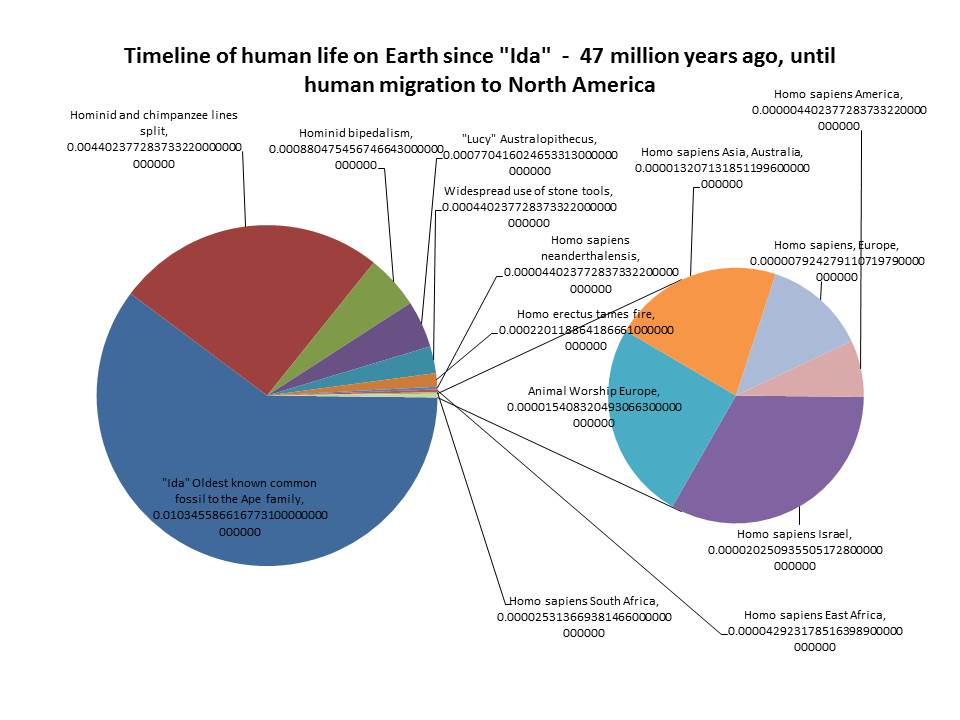
A Human View of History, Time Based on the age of Earth. Welcoming In 2016


Corals and Sponges have been unvarying for 12% of Earth's existence. Beetles have been around for 6% percent of Earth’s history.


The oldest fossil, found to date, common to all apes is 47 million years old.  This time represents 1% of Earth's history.  Hominids and chimps have been on separate evolutionary paths for 0.4% of the time.  Hominids have harnessed fire for 0.02% of history, and Homo sapiens have inhabited North America for 0.0004% of Earth's Time (ET).   


Humans have been consuming wheat for 0.0002% ET, corn, wine, and beer for 0.0001%.   We have shown adoration for gods 0.0001% ET.


The famous battle of Thermopylae (300) has been part of history for 0.000054%.  Hawaii has been known to man for 0.000037% and Jesus has been worshiped for 0.000035% ET.


Gun powder has existed for 0.000025% ET.  The Crusades have been in history 0.0000202%/  Muslims have had Constantinople for 0.000012% of ET.


The Salem Witch Trials, the Bill of Rights, and the end of slavery in the US are separated by 0.0000071% and 0.0000049%, and 0.0000033%.


General Relativity has been published 0.0000022%, and we have been sending objects into space 0.0000012% of ET.


The ability to be outward Atheist: 0.000001%
Mobile phones: 0.0000009%
GPS: 0.0000008%
Human DNA Mapping: 0.0000002%


Dark matter has been known: 0.00000019%
Human machines on Mars: 0.000000066%
High Def pictures of Pluto 0.000000022%


Wednesday, 23 December 2015

When Christmas was Illegal in America – Rethinking the “War on Christmas” from a Historical Perspective.


The Pilgrims of Massachusetts celebrated the first Thanksgiving in 1621 starting a new American tradition; however, they did not celebrate Christmas.  The Puritans when so far as to outlaw celebrating Christmas in 1659 as a statement to newcomers attempting moved in and push Christmas on to New Englanders.  Christmas was either illegal or simply not observed for nearly the first 240 years of Boston’s founding.   The “Christmas Disavowed” period existed in history almost 100 years longer than Christmas has been a legal holiday in Mass.  Wow.

Why was Christmas off the books for so long in New England?  Puritan Christians viewed the Pagan traditions of Christmas as sacrilegious. Tree decoration, yule, holly, gift giving, mistletoe, and caroling were all Pagan traditions adopted by Christmas.  Puritan Christians wanted nothing to do with this.  Not to mention the gluttony at the dinner table combined with drinking, and worst of all game playing.  

From a polar perspective; people have asked me, “as an Atheist do you celebrate Christmas?”, “what do you say to people who tell you Merry Christmas?”  My response is Dec 25th has been known by many names and has been recognized as a celebration of humanity in the northern hemisphere long before Christianity – Yes I celebrate it, what a wonderful time a year!  Moreover, what do I say when people tell me Merry Christmas?  I say Merry Christmas!  The traditional winter holiday may have been called Yule in Germanic paganism or by other names in Roman paganism, but I live in 21st century North America, and we call Dec 25th Christmas.

The traditions of Christmas; taking time out of our busy schedules to spend with our families, to carol, spread the glow, giving gifts, helping others in need, and most of all being humble and thankful – these are all celebrations of humanity.  While the Puritans saw this day as irreverent, the rest of us Christian, Agnostic, and Atheist alike are all enjoying the chestnuts and the shine of lights glittering on the snow.

Merry Christmas and have a Happy New Year.